
Anxiety, Trust & 167 Feet: What Abseiling Taught Me About the Nervous System
An abseil.
Say what now? Throwing myself off a building?
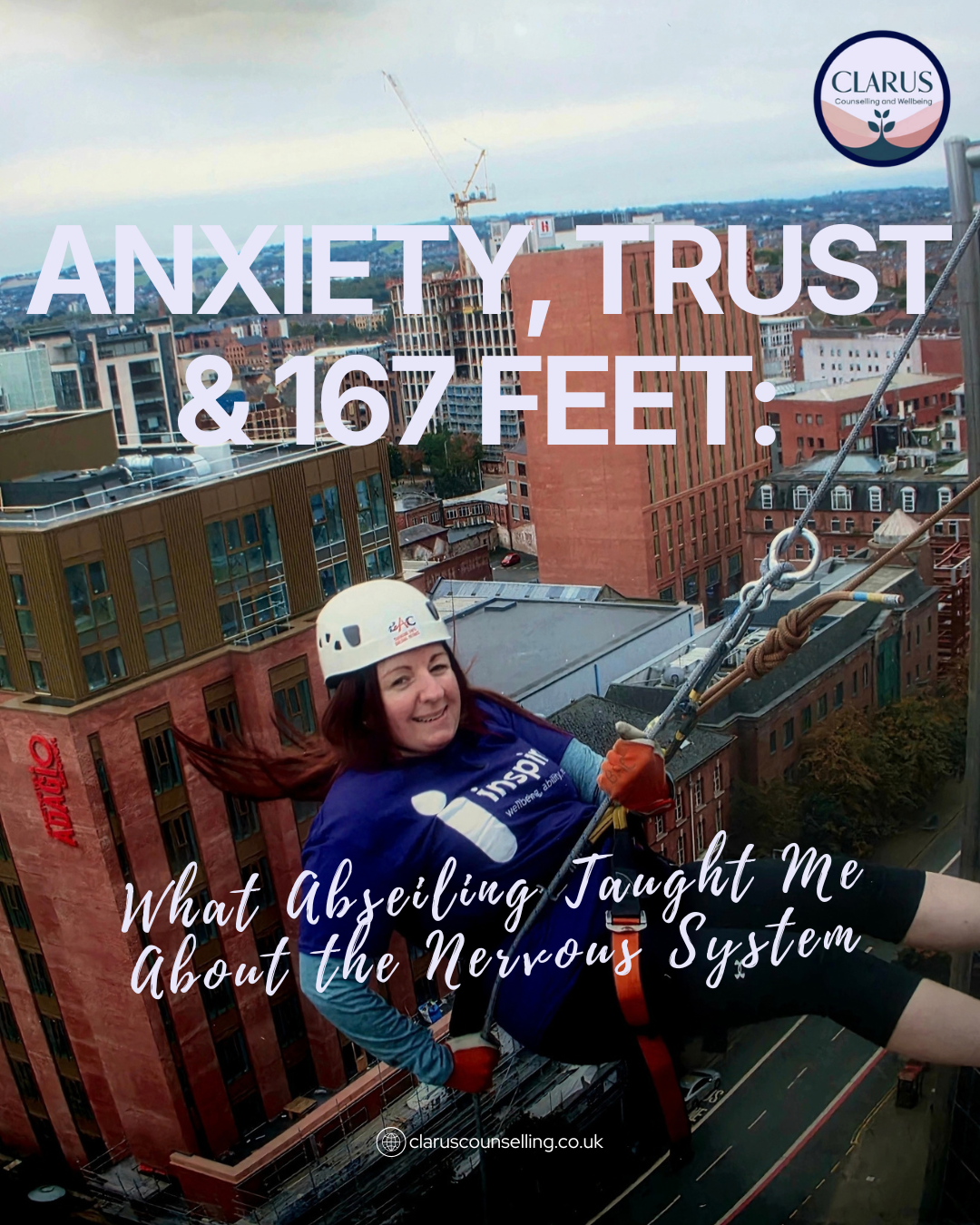
If I’d given it too much thought beforehand, I’m fairly certain the sheer concept would have been vomit-inducing. Yet, there I was: standing on the roof of Belfast’s Europa Hotel, 167 feet in the air, preparing to dangle from a rope for World Mental Health Day to raise money for a mental health charity supporting people affected by addiction.
The theme for World Mental Health Day this year (2026) is “Lived Experiences Heard: Real Voices, Real Change.” As an integrative psychotherapist in private practice, I spend my days helping clients navigate their internal world. But as a human being with my own history, I also live with a nervous system that responds to threat, stress, and fear. Sharing our lived experience bridges the gap between therapist and client, because clinical theory is one thing, but feeling your own heart hammering against your chest on a rooftop is another.
I wanted a challenge, sure. But what actually caught me off guard wasn’t the height – it was the masterclass my body gave me on anxiety.
“That’s Sunday – I don’t need to think about that yet”
In the days leading up to the abseil, I relied on a surprisingly effective coping strategy: compartmentalisation. That’s Sunday’s problem. It doesn’t need thought about until Sunday.
When Sunday arrived, I didn’t let my brain leap to that cliff-edge moment. I chunked reality down to what was right in front of me.
- I’m driving the car.
- I’m filling out a form.
- I’m putting on a harness.
- I’m in the lift.
- I’m taking in a rather lovely view of Belfast.
In therapy terms: Be where your feet are.
Anticipatory anxiety loves the future. It operates on “what ifs” and hypothetical catastrophes, pulling us away from the present moment where we are usually safe. Because I stayed present, I felt surprisingly calm. When people asked if I was terrified, I could honestly answer, “No, I’m fine.” I wasn’t dangling off the ledge yet; I was just standing in the lift.
It was here I noticed how contagious anxiety can be through co-regulation and neuroception, the nervous system’s subconscious ability to detect safety or danger in our environment and in others. Panic was humming all around me in the form of the other abseilers, but by continually checking in with my physical body, I kept my boundary intact: Where are my feet? Am I safe right now? Yes.
Enter Monty (and a total nervous system revolt)
Up on the roof, I met Monty. He was sitting casually on the ledge I was supposed to walk off. I sat beside him, listening intently while he explained the ropes.
Listen carefully, Claire. Pay attention.
Then came the moment.
“Claire, stand up. Turn around. Feet half on, half off the edge.”
OH. HELL. NO.
Suddenly, the threat was no longer theoretical. My brain registered immediate peril, and my autonomic nervous system slammed the big red panic button.
“Monty, I don’t think I can do this. I’m scared.”
My body was instantly flooded with adrenaline and cortisol. Heart hammering, hands trembling, thoughts spiralling. The strangest part? I couldn’t process what Monty was saying to me. He was speaking English, but my brain was so hyper-focused on falling, that his instructions sounded like muffled background noise.
This is the sympathetic nervous system’s fight-or-flight response in full effect. When our brain’s threat centre (the amygdala) senses danger, it temporarily hijacks the prefrontal cortex – the logical, language-processing part of the brain. Blood rushes away from non-essential functions and into large muscle groups, attention narrows down strictly to survival, and high-level reasoning goes offline.
My body wasn’t malfunctioning, it was doing exactly what it evolved to do to keep me alive. Except, in this moment, the threat was deliberate. My anxiety wasn’t irrational; it was actually remarkably sensible.
“Trust me – and trust the rope”
Monty looked at me and said words that cut right through the noise: “Claire, you need to trust me, and trust the rope.”
As someone with lived experience of childhood sexual abuse, trust is not a word I use lightly. It’s something I’ve spent years working through in my own life, learning to trust my own body, trust other people, and believe that safety is actually achievable. Trauma fundamentally alters how our nervous system evaluates threat; it keeps the baseline alarm set higher, making it harder to discern between feeling unsafe and actually being in danger.
So on that windy Belfast roof, I took a slow breath, engaging my vagus nerve to send a signal of safety back down to my heart. I leaned back into the harness. And the rope held me.
The Window of Tolerance (and why my body screamed the whole way down)
Anxiety doesn’t always mean “stop, don’t do it.” Sometimes it just means “pay attention, this matters.” Healthy anxiety gives us useful information. It becomes a problem only when the alarm system gets stuck on high alert long after danger has passed.
As I backed down the hotel wall, my toes barely touching the concrete, I was in a state of hyperarousal. In psychotherapy, we talk about Dr. Dan Siegel’s Window of Tolerance, that optimal zone of nervous system arousal where we can process emotions, think clearly, and feel grounded.
HYPERAROUSAL (Fight / Flight) – Anxiety, racing heart, panic, catastrophic thoughts.
WINDOW OF TOLERANCE (Grounded & Regulated) – Able to reflect, engage, soothe, and process.
HYPOAROUSAL (Freeze / Shutdown) – Numbness, detachment, exhaustion, brain fog.
When stress or trauma exceeds our capacity, we get bumped out of our window:
-
Upwards into Hyperarousal: The fight-or-flight response (panic, agitation, hypervigilance, racing thoughts).
-
Downwards into Hypoarousal: The freeze-or-flop response (numbness, dissociation, helplessness, feeling “blank”).
I was firmly in hyperarousal. I couldn’t look around. I was internally screaming, feeding the rope through inch by inch.
Midway down, I glanced over and noticed faces peeking through the hotel room windows, waving and smiling. Down on the street, people were whooping and cheering. Humanity was everywhere, yet internally, I felt completely alone, fighting a battle no one else could see.
Isn’t that what living with an anxiety disorder or unresolved trauma feels like? Going to work, parenting, smiling, functioning, appearing totally “fine” on the outside… while your internal wiring is screaming that you’re dangling off the edge of a building?
Coming Back to Solid Ground
When my feet finally touched the pavement, I lay myself flat onto the ground. I didn’t care how it looked, my nervous system desperately needed proprioceptive input (feeling firm pressure against the earth) to signal that the descent was over and safety had returned.
Even though the danger was over, my endocrine system needed time to metabolise all that adrenaline. I was shaking, overwhelmed, and completely drained. By mid-afternoon, I was ready for bed.
Ten minutes of acute threat wiped me out for the rest of the day. And it left me reflecting on what it must be like for people who live in that activated state every single day:
- The people who wake up every morning with a pounding chest.
- The people whose nervous systems are constantly scanning every room for threat.
- The people who carry trauma in their bodies, where a hypervigilant nervous system is just trying to protect them from past wounds.
When someone’s nervous system is stuck outside their window of tolerance, it’s less an overreaction, more a learned survival response. And it deserves compassion and understanding, not judgment.
What 167Feet Taught Me
Real change happens when we listen to these real voices, including the voice within our own body.
I didn’t need to eliminate my fear before I stepped off that building. I just needed enough regulation to hear the next instruction. I didn’t need to navigate all 167 feet at once; I just needed to manage the next six inches of rope.
If anxiety is a frequent guest in your life, please know this:
You are not weak because of how your nervous system reacts.
You are not failing because you feel overwhelmed. Your body is trying to protect you, even when its timing is off.
You don’t have to work through it alone.
Sometimes the bravest thing isn’t stepping off the edge. It can be acknowledging your internal storm, reaching out, and letting someone help you expand your window of tolerance so you can find your way back to solid ground.
Staying present. One breath. One step at a time. (And, occasionally… one very long rope.)
Claire.