Grief: Losses Without Flowers
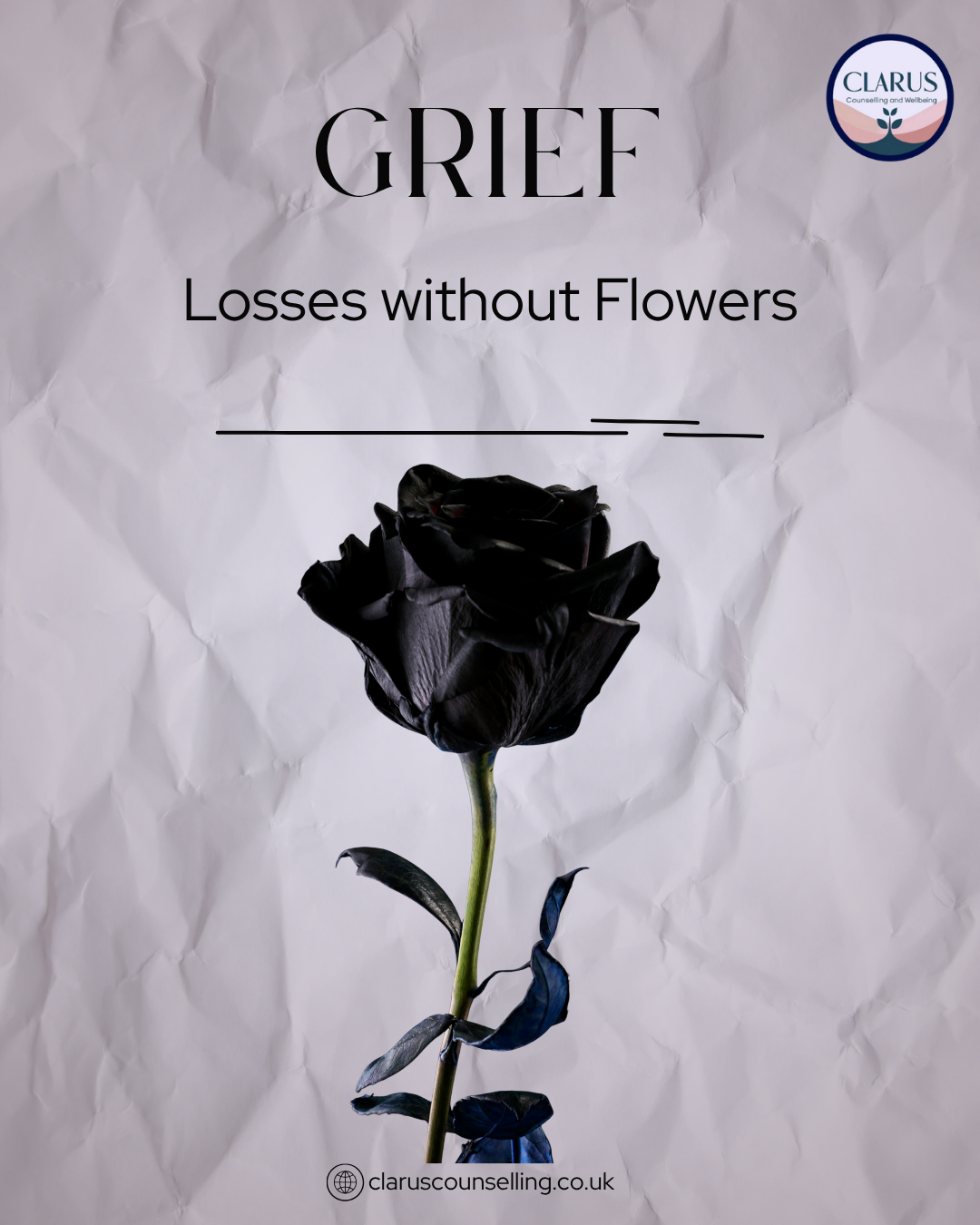
If you had asked me in my earlier years what grief was, I would have answered with absolute certainty. I had lost my grandfather when I was thirteen, so to me, grief was death. It was funerals, sympathy cards, flowers wrapped in crinkled cellophane, and casserole dishes left on kitchen worktops. It was black clothing, tear-stained faces, and the deafening silence that settles over a house after everyone else goes home. Grief belonged strictly to cemeteries.
I know now just how little I understood. Grief is far less polite than that.
It arrives without an invitation and completely refuses to recognise the neat categories we try to build for it. It doesn’t care whether someone has died, moved away, betrayed us, changed beyond recognition, or simply become someone we can no longer reach. It doesn’t even require a death certificate. Sometimes we grieve careers, futures we once took for granted, dreams that quietly dissolve, or versions of ourselves that no longer exist.
It sounds cliché, but grief really is just love and longing, searching for its place.
The messy, raw, unfiltered grief first entered my life in the form of anticipation. My dad was terminally ill for eighteen months before he died. People often speak about the moment of death as the exact timestamp of when grief begins, but for me, it started long before this. Every hospital appointment carried the weight of what might be. Every time ‘Mum’ appeared on my caller ID my stomach would tighten. Every slight improvement brought a surge of hope; every setback stole it away again.
For a lifelong ‘Daddy’s girl’, it was an exhausting way to live – caught in the purgatory of preparing for the worst while desperately praying that the day would never come. I didn’t know back then that there was a clinical name for this: anticipatory grief. Our minds try to slowly digest the unimaginable before it actually happens. But being taught the terminology never lessened the heartache.
When Dad finally died, a thought crossed my mind that felt entirely wrong: the wait was finally over.
That thought came wrapped in an immediate layer of guilt, because we aren’t taught that relief and heartbreak can coexist in the same room. But they can. Watching someone you love suffer is its own slow execution. Death simply changes grief’s address.
Almost nine years have passed now, and people sometimes ask me if the grief has gotten any easier. I don’t think that’s the right way to frame it. The grief doesn’t shrink. Instead, I’ve come to understand what the grief theorist Lois Tonkin meant when she suggested that we don’t move past grief; we grow around it. Immediately after a loss, grief consumes your entire life; it fills every corner of your existence. Over time, your life begins to expand. You meet new people, you find new routines, and you absorb new experiences. The grief remains the exact same size, but it is no longer the only thing there.
It stops feeling like a constant, violent storm and starts behaving more like the tide. Most days the sea is calm, and you learn how to live beside it. Then, unexpectedly, a specific song, a passing smell, a vivid dream, an old photograph, or the simple sight of a Father’s Day card pulls the tide right back in. You are soaked to the bone before you’ve even realised the water has reached you. And still, somehow, you survive it. Again.
A few years later, on Christmas Day, I found myself sitting beside my maternal grandmother as she took her final breath; a woman I had loved dearly and grown close to in adult life. There are moments in life that permanently divide your timeline into a distinct “before” and “after.” That was one of mine.
There was something profoundly sacred about witnessing death so closely. It wasn’t frightening or dramatic; it was astonishingly peaceful. For all of our collective human fear of dying, her departure itself was remarkably gentle. The room became perfectly still. Time slowed down. Somewhere inside that silence, I understood something no textbook could have ever taught me: love doesn’t leave the room simply because breath and a heartbeat stop.
Not all grief, however, comes with a service and a burial. Some losses never receive flowers. One of the deepest griefs of my life belonged to someone who was still very much alive.
When I was eighteen, my paternal grandmother chose to end our relationship. She disapproved of my lifestyle choices and abruptly closed the door on me. There was no final conversation, no opportunity to repair the rift, and no goodbye. Simply absence and rejection.
For over a decade before she actually passed away, I had already been mourning her. People rarely speak about the unique agony of disenfranchised grief – a loss that isn’t openly acknowledged or socially validated. When someone dies after years of estrangement, outsiders assume the grief once again begins at the funeral. In reality, it began years earlier. By the time her funeral arrived, I wasn’t grieving the woman she was; I was grieving the grandmother I had always hoped she might one day have chosen to be.
In some instances grief isn’t about losing what we had, it’s mourning what we never received. That loss quietly reshaped the way I understood grief. Until then, I had unconsciously believed grief belonged only to death. Yet here I was, mourning a relationship that had never really been allowed to exist. It challenged everything I thought I knew about loss. More importantly, it changed the way I would later sit with the people who came to me seeking support. If grief had taught me anything by this point, it was that it stubbornly refuses to fit inside the neat definitions we try to give it.
As a counsellor, clients often ask me what their grief is supposed to look like, and I always wish I could give them a straightforward answer. The truth is, it looks like tears, but it also looks like unprovoked laughter. It looks like scrubbing the kitchen at two in the morning because lying with your thoughts hurts too much, and it looks like a heavy, total numbness.
Contrary to popular belief, grief is not a neat, linear progression through five predictable stages. Elisabeth Kübler-Ross’s work was monumental in helping us understand the emotional architecture of terminal patients, but human grief rarely behaves like a checklist. We don’t complete denial, hand in our homework, and move neatly into anger, then bargaining, then depression, before finally arriving at acceptance like we’re ticking boxes on a form.
Grief is a cycle. You constantly revisit places you thought you’d left behind weeks or even months ago. Acceptance on Tuesday can easily unravel into anger by Thursday. A single memory can transport you backward twenty years in the space of a heartbeat. Nothing has gone wrong when this happens; that is simply the chaotic, natural rhythm of the human heart processing loss.
William Worden approached this beautifully by looking at grief not as passive stages we suffer through, but as tasks we actively navigate. It’s a process of accepting the reality of the loss, processing the pain, adjusting to an environment where the old reality is missing, and eventually finding a way to maintain a connection to what was lost while still investing in life. It takes work, and it is never a straight line.
It would take me many more years to fully appreciate just how right those grief theorists were. Ironically, one of the greatest lessons grief ever taught me didn’t come through bereavement at all. It arrived disguised as a resignation letter. For years I thought I understood grief because I had buried people I loved. Life would later show me that some of the hardest endings are the ones where nobody dies.
I was caught most off guard when I chose to leave an organisation I had been a part of for over a decade. Even writing those words down still feels slightly strange. How could me freely making that choice hurt so deeply?
The reality was that it wasn’t just a job. It was my community, my daily routine, my sense of purpose, and a massive pillar of my identity. It held close friendships, shared victories, ordinary Mondays, and extraordinary breakthroughs. It held countless quiet, vulnerable conversations tucked away in the staff kitchen. It held laughter, and it held many of my dreams. When I resigned, I wasn’t just handing over my laptop and my keys, I was closing the book on an entire chapter of my life.
What hurt the most wasn’t just the exit itself; it was the painful discovery that certain relationships only survive within the walls where they were built. For years, I had heard the comforting refrain, “We’re one big family here.” Until I left.
Then I learned the stark difference between family and colleagues who happen to share a postcode. That realisation was brutal. It wasn’t because the people were insincere; some of them genuinely cared. It was because some environments often create a false sense of proximity that we mistake for permanence. Sometimes, when the environment disappears, the relationship evaporates with it. That truth broke my heart.
For months, I mistook that grief for anger. I wanted accountability. I wanted apologies, recognition, and for someone to simply look me in the eye and say, “Yes, our actions hurt you.” I genuinely believed that acknowledgement was the missing key to my healing. It has never come.
Somewhere along that painful road, I realised something deeply uncomfortable: waiting for someone else’s insight had quietly become another way of handing them control over my own recovery. Validation was never theirs to own, and it wasn’t mine to wait for. One of grief’s greatest cruelties is that it demands we accept things exactly as they are, rather than as we desperately wish they could be.
I often tell my clients that grief is the price we pay for loving. I would add a caveat to that now: grief is also the price we pay for growing. Every meaningful season of life eventually asks us to let go of something. Sometimes it’s people. Sometimes it’s places. Sometimes it’s old identities or the comforting illusion of certainty.
Leaving that organisation taught me something I hadn’t fully appreciated before. Every meaningful relationship we build carries the possibility of grief. Some endings arrive dramatically; others happen so quietly that we barely notice them until one day we realise someone who once knew everything about our lives has become a stranger. Loss doesn’t always announce itself. Sometimes it simply fades into silence.
I have lost close friendships too. Not through the finality of death, but through changing values, unspoken misunderstandings, and lives that slowly and quietly drifted in different directions. Those losses deserve a period of mourning. Friendship breakups rarely receive public acknowledgement or sympathy cards, yet they can leave us questioning our worth in ways that physical death never does. Looking back now, my father, both grandmothers, the organisation, and those friendships may appear to be entirely separate stories. Yet beneath each of them lay the same questions: Why do people leave? Was I enough? Where do I truly belong? Could I have done more? Should I have said less? Was I too much?
It slowly dawned on me that I wasn’t grieving four or five different losses. I was grieving through the same heart. Each loss touched on something older than itself, awakening familiar feelings of rejection, abandonment, and longing that had existed long before the event itself. Grief has a remarkable ability to awaken old wounds we thought had long since scarred over. It has an extraordinary way of introducing us not only to what we have lost in the present, but to the deep, limiting beliefs we’ve carried about ourselves for years. Often, we aren’t just grieving today’s event; we are grieving every single familiar feeling that came before it.
And yet… despite everything grief has taken from me, it has also given me something back.
It has softened my sharp edges. It has made me much slower to judge another person’s invisible battles. It has taught me that true strength rarely sounds loud or boastful; it usually looks like quietly doing the school run the morning after your entire world has changed. It has shown me that healing is not about forcing yourself to forget, but rather learning how to remember without becoming trapped by the memory.
Most of all, grief has taught me that life demands we love despite the absolute certainty that we will eventually lose. Every parent knows that one day their children will grow up and leave the nest. Every spouse knows that one day, statistically, one of them will attend the other’s funeral. Every friendship carries the implicit possibility of an ending. Every dream contains the potential to change shape. That isn’t pessimism, it’s the reality of loving deeply in a world where nothing lasts forever.
We live, and we love anyway. Not because the loss isn’t coming, but because the love has always been worth the risk.
Perhaps that is the ultimate lesson grief has spent all these years trying to teach me. It isn’t only about what has been taken away from us. It is about having the radical courage to keep your heart open and keep loving in a world where nothing is ever guaranteed.
And when you think about it, that might just be the bravest thing any of us can ever do.
Claire.